


Development of a HCV vaccine candidate
Annually, hepatitis C virus (HCV) infects around 1 million people worldwide. Many people with HCV develop serious complications like cirrhosis or liver failure. Treatments exist but they can be costly, outcomes can vary and they’re not a long-term solution. A vaccine is the most effective way to prevent the spread of infectious diseases. However, there’s currently no HCV vaccine, a critical gap in global health.
Objective
Hepatitis C virus is one of the most genetically diverse human viruses. It has 7 major genotypes and over 67 subtypes that differ by up to 33% at the nucleotide level. This diversity makes vaccine development particularly challenging. Other factors contributing to the difficulty include uncertain immune correlates of protection and viral immune evasion strategies such as glycan shielding and hypervariable regions.
Our goal is to develop a vaccine that overcomes these hurdles by looking at immune responses on conserved regions of the E2 glycoprotein. These are critical targets of broadly neutralising antibodies.
Using structure-guided design and mRNA technology, we’re advancing vaccine candidates capable of inducing strong, cross-genotype protection.
The aim is to progress to Phase 1 human clinical trials.
Approach
Hepatitis C virus evades the immune system through extensive genetic diversity and structural features. The latter includes variable regions and glycans within the E2 glycoprotein. These limit the development of bNAbs.
To address this, we’ve developed a vaccine candidate utilising a modified form of E2Δ123 where all three variable regions are deleted.
This modified protein is more readily recognised by bNAbs. It elicits broader, more potent antibody responses than conventional E2 vaccines.
Notably, bNAbs induced by E2Δ123 neutralise all seven HCV genotypes in vitro.
Community impact
Intellectual property
Three patents protect the intellectual property of this technology.
Drummer, HE, Poumbourios, P and McCaffrey K
Granted in Australia, USA, China, South Korea and Japan.
Under examination in other jurisdictions.
Drummer, HE, Poumbourios, P and McCaffrey K
In national phase.
Granted in Australia.
Under examination in other jurisdictions.
Drummer, HE, Poumbourios, P and McCaffrey K
In national phase.
Granted in USA.
Under examination in other jurisdictions.
Opportunity
Outcomes could include:
- generation of a prophylactic HCV vaccine
-
use of a prophylactic HCV vaccine in conjunction with DAA’s to prevent re-infection.
Market
HCV is estimated to chronically infect around 58 million people worldwide and contribute to approximately 290,000 deaths. Direct acting antivirals (DAAs) are highly effective at curing HCV in people with known HCV infection. However, a vaccine will be required to prevent new infection and prevent reinfection in those treated with DAAs.
A vaccine can support a DAA elimination program by reducing the required number of treatments per year by 23 for every 1000 PWID (90 percent vaccine efficacy, 50 percent initial prevalence of HCV).
The current estimated prevalence of the disease in the major markets are:
- USA
Prevalence rate approx. 1%; approx. 2.7 million infected individuals. - China
Prevalence rate 2–8%; approx. 30 million infected individuals. - Europe
Prevalence rate approx. 4%; approx. 8 million infected individuals. - Asia and Pacific regions
Prevalence rate 1–5%; more than 40 million infected individuals.
Partners
Funding partners
- ACH4
- mRNA Victoria
Collaborators
- Monash Institute of Pharmaceutical Sciences
- University of NSW
- University of Adelaide
- University of Copenhagen
- University of Melbourne
- Kirby Insitute
Project contacts

Professor Heidi Drummer
Deputy Director, Impact; Scientific Director for Research Translation; Scientific Director, Burnet Diagnostics Initiative; Principal Investigator, Burnet Vaccine Initiative; Co-Head, Viral Entry and Vaccines Group
Project team
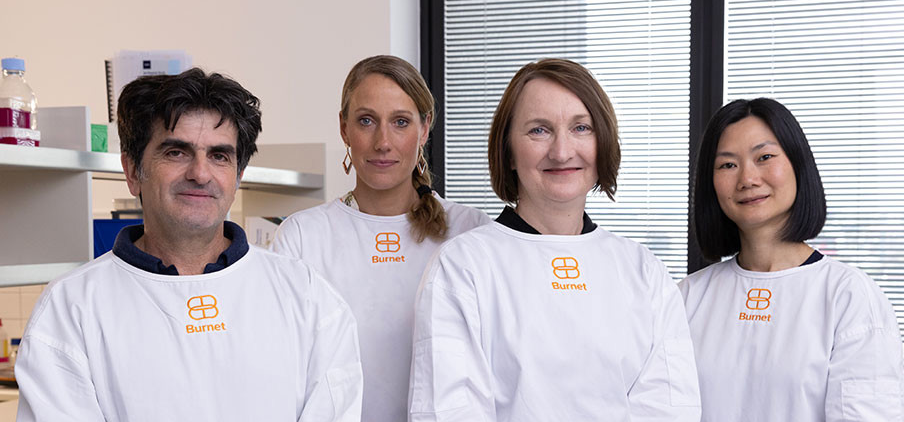
Professor Heidi Drummer
Deputy Director, Impact; Scientific Director for Research Translation; Scientific Director, Burnet Diagnostics Initiative; Principal Investigator, Burnet Vaccine Initiative; Co-Head, Viral Entry and Vaccines Group

Dr Andy Poumbourios
Honorary Associate
