
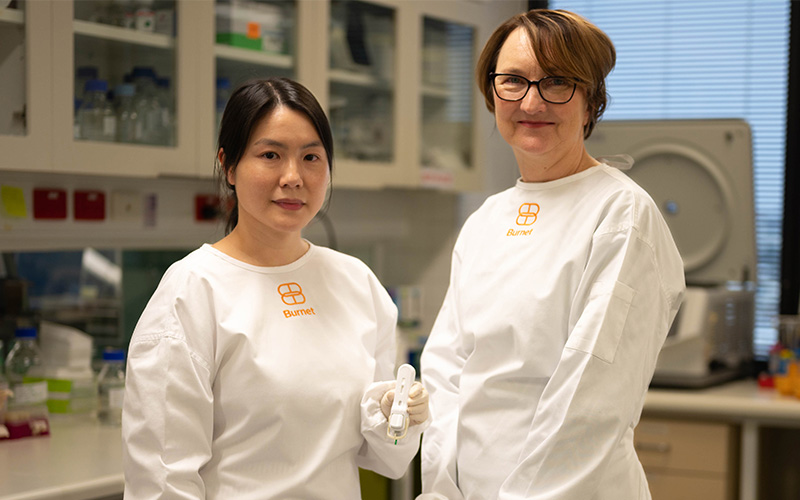


Dr Tafireyi Marukutira and Dr Kennan Witari at the symposium.
Published 30 September 2026
Pacific HIV Symposium focuses on urgent regional response
People

Media enquiries

Last month, countries in and around the Pacific came together for the Pacific HIV Symposium 2026 to address rising rates of HIV in Pacific island countries.
Fiji is currently facing the fastest growing HIV epidemic in the world. One baby is born with HIV every week and one child under the age of 5 is dying from an AIDS-related illness every month.
Papua New Guinea also recently declared a national HIV crisis, with an estimated 30 new infections every day.
The Pacific HIV Symposium 2026 was established to help countries band together to respond to the crisis.
The Symposium brought together key health experts, regional health leaders, clinicians, nurses and community organisations from across the Pacific, Australia and Aotearoa/New Zealand to focus on the actions that can be taken to curb the rising rates of HIV in the region.
Burnet was represented at the symposium with people from across our health programs, including staff from our offices in Vanuatu and Papua New Guinea.
Burnet Senior Research Fellow Dr Tafireyi Marukutira, who attended the symposium, said it was a valuable opportunity for country representatives to come together and share learnings and experiences.
“Four decades on from the global HIV pandemic, there is a lot we have learnt and can use to combat the current outbreak,” he said.
Dr Marukutira said with the Pacific island countries being some of our nearest neighbours, there was a keen interest for Australia to assist in the response.
“With population movement, we know how easy it is for the disease to spread so if it is a problem for our nearest neighbours, it is something we need to take very seriously and this symposium was evidence of that.”
The Australian Government has invested $48 million in supporting the response in the Pacific islands to help contain the spread of HIV through technical assistance, disease surveillance and co-investment in their national public health responses.
Dr Marukutira said with significant funding to support the response, curbing the increasing rates of infection was possible.
“The Pacific island countries have the funding, technical knowledge, treatments and prevention strategies available to get on top of this.”
He said testing was key to controlling the outbreak.
He said having HIV and other health issues together also increased the risk of more serious health complications.
“HIV lowers your immune system, which increases your risk of other infections. Particularly in Pacific countries where there is a high incidence of tuberculosis, we need to test people in the clinics because the last thing we want is to have a concurrent outbreak of HIV and tuberculosis occurring together.”
Dr Marukutira said there is also a need to engage women in antenatal clinics to test them to ensure they don’t pass HIV onto their newborns.
"Testing in pregnancy is vital to reduce the spread of HIV to newborns."
Dr Marukutira said the overwhelming message from the symposium was one of positivity.
"We have the tools and knowledge to get on top of this outbreak.
"There is no excuse."