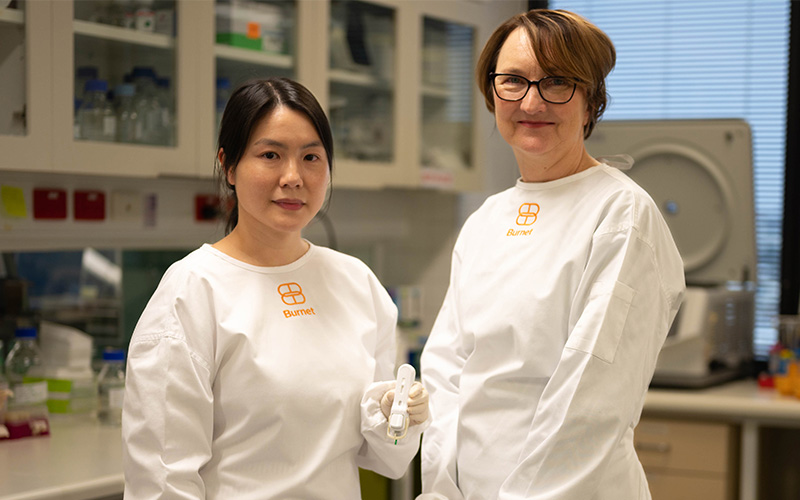
Burnet collaborators win Eureka Prize for bacterial vaginosis breakthrough
The Women’s Microbiome Innovation Group, comprising researchers from Melbourne Sexual Health Centre, Monash University and Alfred Health, has won the 2026 Australian Infectious Diseases Research Centre Eureka Prize for Infectious Diseases Research.
The group, led by Professor Catriona Bradshaw, Dr Lenka Vodstrcil and Dr Erica Plummer, was recognised for research demonstrating that bacterial vaginosis (BV) is sexually transmissible and that treating male partners can substantially improve cure.
BV affects around one in four women of reproductive age globally. It occurs when protective vaginal bacteria, particularly Lactobacillus species, are depleted and replaced by a more diverse group of bacteria. Until recently, it was largely regarded as an imbalance occurring independently in women, despite high rates of recurrence after antibiotic treatment.
The group’s StepUp trial, published in the New England Journal of Medicine, showed that reinfection from an untreated partner is a major driver of recurrence.
Within 12 weeks, BV returned in 35 per cent of women whose male partners received concurrent oral and topical antibiotic treatment, compared with 63 per cent of women whose partners were not treated.
The findings have already changed clinical practice. The Australian STI Management Guidelines now recommend concurrent treatment for ongoing male partners of women receiving treatment for BV.
The award-winning research is closely connected to Burnet’s work to improve women’s sexual and reproductive health.
Burnet Head of Life Sciences Professor Gilda Tachedjian leads EVE-M, a research program whose collaborators include Professor Bradshaw, Dr Vodstrcil and Dr Plummer.
While StepUp addresses sexual transmission and reinfection, EVE-M is developing complementary, antibiotic-sparing approaches to restore and sustain a protective vaginal microbiome.
“The StepUp trial is a significant advance because it identifies reinfection as a key driver of recurrence and translates that knowledge into a practical improvement in care,” Professor Tachedjian said.
“Through EVE-M, we are working closely with Catriona, Lenka and Erica on complementary approaches to restore and sustain a protective vaginal microbiome.
“Together, these strategies could help break the cycle of BV and reduce its broader impacts on women’s sexual and reproductive health.”
The collaboration also extends to the health economics of partner treatment. Burnet Deputy Program Director of Women’s, Children’s and Adolescents’ Health Associate Professor Lindi Masson co-authored a 2026 economic analysis of the StepUp findings.
The study found that concurrent partner treatment was cost-saving in models of both the Australian and South African health systems, strengthening the evidence for its adoption in clinical guidelines.
Burnet’s work in this field is continuing to expand. Professor Tachedjian recently received a $3.04 million National Health and Medical Research Council Investigator Grant for a five-year program investigating the protective properties of beneficial vaginal bacteria and lactic acid, with the aim of developing new interventions for BV, sexually transmitted infections and poor birth outcomes.
Congratulations to Professor Bradshaw, Dr Vodstrcil, Dr Plummer and the Women’s Microbiome Innovation Group on this significant recognition.