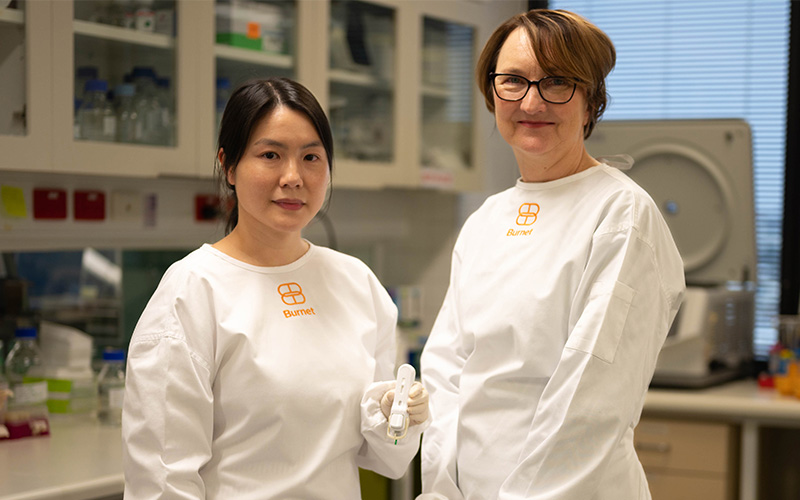
Professor Heidi Drummer recognised for research career and impact
Burnet Institute Deputy Director of Impact, Professor Heidi Drummer, has been recognised for a research career spanning virology, vaccine development, diagnostics and research translation, receiving one of the Australian Society for Microbiology’s (ASM) major honours for 2026.
Professor Drummer was named the ASM Distinguished Award Orator for 2026, recognising an “outstanding Australian who is active as a current global leader in their field and whose work has had a far-reaching impact within and beyond the field of microbiology”.
Professor Drummer is also Scientific Director of Burnet Diagnostics Initiative and Co-head of the Vaccines and Viral Entry working group.
Her work has focused on understanding how viruses enter cells, how immune responses can prevent infection, and how scientific discoveries can be translated into tools that improve health.
Delivering her oration at the ASM scientific meeting on Monday, Professor Drummer shared insights on hepatitis C and syphilis elimination – both of which remain significant public health challenges.
Her oration reflected on more than two decades of work in hepatitis C vaccine research, including efforts to understand the virus’ structure, how it enters cells, and how vaccine approaches might generate protective immune responses.
Professor Drummer said her work had reinforced the importance of industry partnerships, while also showing the need to evaluate technologies critically, “even when the science is strong and the history is meaningful”.
“Basic science is the engine of translation,” she said.
She also urged researchers to ‘mind the gap’ between lab-based prototypes and phase 1 or phase 2 testing.
“That gap requires money, specialist skills, manufacturing capability, regulatory expertise and the resources to de-risk a product properly before it reaches people,” she said.
Professor Drummer said her experiences had helped her understand the key to research translation success.
“Understand the unmet need, the user, the market, the regulatory pathway and the performance requirements, then work backwards,” she said.
“Back yourself and your science, invest deeply in discovery, understand the real-world problem, and build the partnerships needed to translate ideas into tools that make a difference.”
For Professor Drummer, the path from discovery to impact is not only a scientific challenge, but a collaborative one – requiring researchers, industry, funders and communities to work together so promising ideas can reach the people who need them.