

Victoria Stone: Living with long COVID
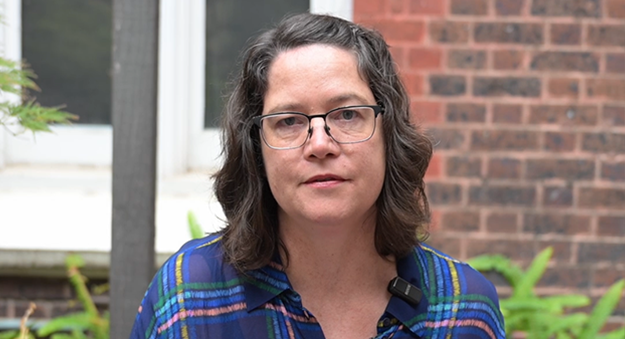
Long COVID continues to affect a great many in our community. Victoria Stone, a supporter of Burnet, is someone who has suffered immensely.
Your gift today has the power to unlock ground-breaking research into a universal COVID vaccine.
Long COVID continues to affect a great many in our community. Victoria Stone, a supporter of Burnet, is someone who has suffered immensely.
Here you can read Victoria's personal experiences in her own words, taken from a submission she made to the House of Representatives Inquiry into Long COVID and repeated COVID infections.
The inquiry aims to build a picture of the health, social, educational, and economic impacts of long COVID and repeated COVID infections on individuals, families and the Australian community. The idea is that submissions will inform public policy recommendations.
In her own words: Victoria's letter
"COVID has affected each member of my family to various extents. My husband and I have two children, who at the start of the pandemic were aged 1.5 and 3."
"My husband had a pre-existing health condition, an auto-immune kidney disease that makes him severely immunocompromised. The rest of us would have been considered ‘healthy’ and took no regular medication.
"In the very early days of the pandemic my husband came back from a work event attended by a large group of people from Milan, Italy, which was soon to become the epicentre for the European outbreak of SARS-CoV-2.
"Within a week we had all developed chesty coughs, I lost my sense of taste and smell completely for two weeks.
"12 days later my (then) 3 year old, Alice, was hospitalised with a massive seizure.

Alice, Victoria's daughter.
"From the emergency call, it was 22 minutes before the ambulance arrived, and a further 20 minutes before she was given the buccal that finally stopped her seizure.
"Thankfully her head CT was clear, and the seizure was deemed to be of unknown origin.
"My infection with COVID would be considered ‘mild’.
"My sense of taste and smell began gradually returning two weeks later and to all intents and purposes I was fine and fully recovered.
"Or so I thought.
"I was taken to hospital with a suspected transient ischaemic attack (TIA). A TIA happens when the blood supply to your brain is blocked temporarily. The signs are the same as for a stroke, but they disappear within a short time. Often, they are only present for a few minutes.
"While all results were thankfully normal, the symptoms persisted.
"Ever since this first hospital visit, I have continued to suffer from chest pains, tinnitus, right sided neuropathy, including ‘glove arm’ and ‘glove leg’ – plus freezing cold right hand and right foot.
"I was exhausted! I gave up trying to find answers and tried to ignore and live with the new symptoms.
"In late 2021, I met our new GP who said “I believe you! I have four other patients who have the same neuropathy symptoms post-COVID”.
"It was life-changing to hear that, and although I still have no answers for the extent of the damage caused by that initial first wave infection, I am grateful to have a GP that is so knowledgeable about transmission and the risks."

Victoria and her son
"The neurological and cardiovascular damage that I have endured over the past three years has been, and continues to be, incredibly disruptive to my life. I hope there will be no lasting damage to my body."
—Victoria Stone
Burnet submission to the Inquiry into Long COVID
Burnet also made a submission to the Inquiry into Long COVID and repeated COVID infections.
Findings in the Burnet submission include:
- between 500,000 and one million Australians have or have had Long COVID, and the condition may persist for at least two years
- females, people aged 30-49, ethnic minorities and the socio-economically disadvantaged are at higher risk of Long COVID
- a third dose (booster) of a COVID-19 vaccine reduces the risk of Long COVID by up to 50 percent
- currently, there is no evidence-based specific treatment for Long COVID.
Meanwhile, in the Burnet laboratories

Dr Andy Poumbourios
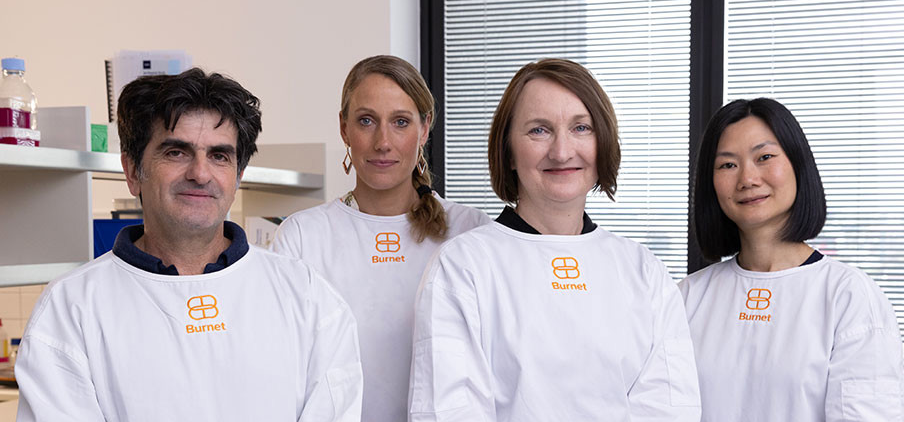
Back in 2021, Professor Heidi Drummer and Dr Andy Poumbourios and their team discovered a way to improve the effectiveness of COVID vaccines.
They introduced mutations into the COVID-19 spike protein that made it extremely stable. This stability resulted in antibody responses that were broadly effective against SARS-CoV-2 variants - in other words, a vaccine candidate with the potential to be a universal COVID vaccine.
With thanks to donors we were able to complete proof-of-concept studies. Now it’s time for the next step, and this is where we need your help.
—Dr Andy Poumbourios
With successful validation completed, we can then approach potential partners to move on to human trials, regulatory approval and production. That means more effective COVID-19 vaccines ready for arms here in Australia and around the world.

Dr Poumbourios explains Burnet's work towards a universal Covid vaccine
Donate now
Your gift today has the power to unlock ground-breaking research into a universal COVID vaccine.